Climate · 2,494 words · 11 min
What a BTU buys: matching portable AC to a room
Air conditioning is sold on one number, and the number is routinely misread. A BTU rating tells you how much heat a machine can move, not whether it will make your bedroom comfortable, and the two questions meet only when the room itself enters the calculation.
We make 6 portable air conditioners spanning 8,000 to 14,000 BTU, we print a square-footage rating beside every one of them, and this guide is the long answer to the question those two figures raise together: which machine fits which room, why bigger is genuinely not better, and what the modes on the control panel are actually for.
What a BTU is, and what a portable AC is
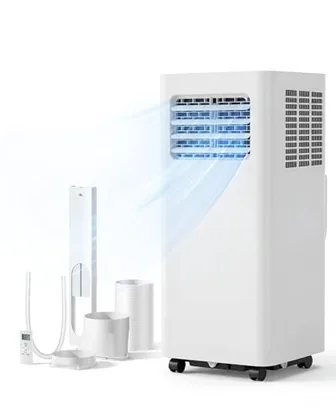
Portable Air Conditioners
8,000 BTU Portable Air Conditioner
$159.99


BTU stands for British thermal unit, the heat needed to raise one pound of water by one degree Fahrenheit. An air conditioner's rating counts how many of those units it can move out of a room in an hour. It is a rate, not an amount: a 10,000 BTU machine shifts heat at ten thousand units an hour for as long as it runs.
That heat has to go somewhere, which is what the exhaust hose in the box is for, and it is the detail that separates this category from a fan.
The category itself has a precise definition. The federal department that writes efficiency rules for appliances defines it this way:
“portable air conditioner” means a portable encased assembly, other than a “packaged terminal air conditioner,” “room air conditioner,” or “dehumidifier,” that delivers cooled, conditioned air to an enclosed space, and is powered by single-phase electric current.
Two phrases in that definition carry the practical meaning. An encased assembly: the whole machine lives in the room with you, on castors, rather than split across a window sill or a wall. A source of refrigeration: there is a real compressor inside, the same species of machine as in our 12-volt fridges, moving heat rather than merely stirring air. Everything else about the category follows from those two facts, including the noise, the hose, and the reason it can do what no fan can.
The square-foot rating is the honest number
A BTU figure without a room size attached is a horsepower number without a car. What you actually want to know is coverage, so on our pages the square-footage rating sits next to the BTU figure for every unit, and the whole line lays out like this:
| Model | BTU | Rated for | Price |
|---|---|---|---|
| 8,000 BTU Portable Air Conditioner | 8,000 | 350 sq.ft | $159.99 |
| 8,000 BTU Portable Air Conditioner | 8,000 | 350 sq.ft | $159.99 |
| 10,000 BTU Portable Air Conditioner | 10,000 | 450 sq.ft | $179.99 |
| 10,000 BTU Portable Air Conditioner | 10,000 | 450 sq.ft | $169.99 |
| 12,000 BTU Portable Air Conditioner | 12,000 | 600 sq.ft | $219.99 |
| 14,000 BTU Portable Air Conditioner | 14,000 | 750 sq.ft | $239.99 |
Read the table from the room, not from the machine. Measure the space you intend to cool, length times width, and find the smallest unit whose rating covers it with something to spare. A bedroom of 250 square feet lands comfortably in the under-500 group. An open-plan space pushing 700 square feet is what the over-500 group exists for, with the 14,000 BTU unit rated to 750 square feet at the top of the line.
The ratings assume an ordinary room. Real rooms have quirks, and they nudge the choice in predictable directions. A kitchen fights its own appliances, so it behaves a size larger than the tape measure says. A top-floor room under an uninsulated roof does the same on hot afternoons.
A wall of west-facing glass adds load in the evening exactly when you want the machine to be winning. None of these turn arithmetic into guesswork: they mean that a room near the top of a unit's band, plus one of these quirks, is a reason to step up one unit, once.
Why oversizing backfires
The tempting mistake runs the other way: skip the arithmetic and buy the biggest machine on the shelf. The department that writes purchasing guidance for air conditioners is blunt about where that leads:
Oversizing room air conditioners will increase the purchase cost and lead to higher energy consumption and poor humidity removal due to excessive on-off cycling.
The mechanism is worth understanding, because it is not obvious. Cooling a room is only half of comfort. The other half is pulling moisture out of the air, and moisture removal happens while the machine runs. A grossly oversized unit slams the thermometer down in a few minutes and switches off before it has dried anything, then repeats the cycle all evening.
The room ends up cold and clammy at once, the compressor wears its start-stop cycles, and the electricity meter records the whole performance. A correctly sized machine runs in long, quiet spells, and the long spells are where the dry, even comfort comes from.
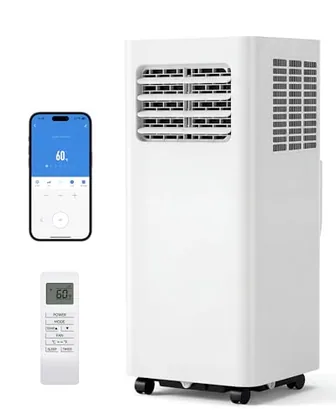
Portable Air Conditioners
12,000 BTU Portable Air Conditioner
$219.99
So the rule has two edges. Undersized, the machine runs flat out and never catches the room. Oversized, it catches the room instantly and never does the second half of its job. The square-foot rating is the path between the two, and the arithmetic is a better guide than the top of the line.
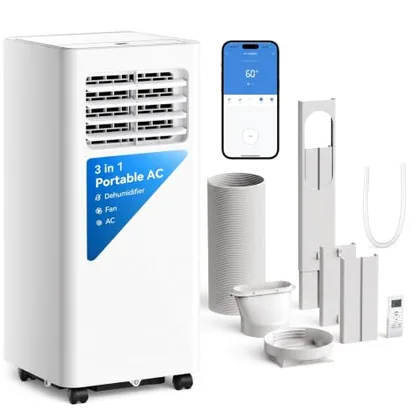
Three machines in one cabinet
Most of our units are three-in-one machines: air conditioner, dehumidifier and fan, each mode usable on its own. The modes are not marketing variety. They are the same hardware doing different halves of the comfort job, and each earns its place in a different week of the year.
Cool is the headline act: compressor on, hose out the window, heat leaving the room at the rated BTU. This is the mode the sizing arithmetic above is about.
Dehumidify runs the refrigeration circuit to wring water out of the air without chasing a low temperature. Muggy shoulder-season days, drying a laundry room, a basement that feels damp rather than hot: this mode covers the weeks when moisture, not heat, is the complaint. It is quieter work for the compressor, and on many humid days it delivers more felt comfort per watt than full cooling would.
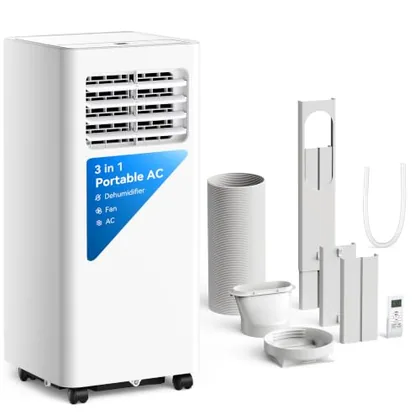
Portable Air Conditioners
10,000 BTU Portable Air Conditioner
$169.99
Fan moves air with the refrigeration off entirely, at a fraction of the draw. Mild evenings, or keeping air stirring overnight after the room is already cool, belong to this mode.
The practical habit is to stop treating the unit as a single-purpose summer machine. A three-in-one earns its floor space from the first sticky week of spring to the last damp week of autumn, and choosing modes deliberately is also the cheapest efficiency upgrade there is: every hour the compressor does not need to run costs nearly nothing.
The hose is not optional, and where the machine lives matters
A portable air conditioner is a heat pump, and the exhaust hose is the pump's outlet. Every unit ships with a window mounting kit that seals the hose into a partly opened window. Three placement rules cover almost every installation question we hear.
It sounded like something inside the unit was violently striking the housing.
Keep the hose short, straight and uncrushed. Every extra bend holds hot air inside the room's envelope, and a hose flattened behind a sofa is the classic reason a healthy machine seems to underperform. The kit's geometry is the design intent: machine near the window, hose in a gentle rise.
Seal the window gap properly. The mounting kit's panel closes the opening the hose passes through. Left loose, the gap feeds warm outside air straight back into the room, and the machine gets to cool the neighbourhood. Thirty seconds with the kit's seals repays itself all summer.
Give the intake room to breathe. Like our fridge compressors, the machine needs free airflow around its grilles to move heat efficiently. Hard against curtains or wedged in an alcove, it re-breathes its own exhaust. A hand's width of clearance on the vented faces is enough.
I ultimately had to press the manual reset/test protection button on the power cord to cut power to the unit.
Condensate deserves one sentence of honesty: cooling humid air produces water, most of it leaves as vapour through the hose on modern units, and heavy dehumidifying days may still fill an internal tank that wants emptying. The unit's own manual states its drainage arrangement, and that page beats any general guide, this one included.
Noise, sleep and the castor question
The compressor that makes the cold also makes the sound, and a portable unit keeps both in the room. The stated noise class for each unit is on its page.
Three placement habits soften the sound that remains. A rug under the castors takes the edge off hard-floor hum, and distance from the bedhead matters more than absolute volume. Run the room cold in the hour before sleep, then drop to fan mode, for the quietest night on the least power.
The castors are the point of the category and worth using deliberately. A single unit can cool the home office through the workday and the bedroom in the evening, which is how a household with one well-placed machine often beats a household with two badly placed ones. The window kits are the fixed cost of that mobility: a second kit in a second room turns the move into a two-minute job rather than a renovation.
Portable against the alternatives
We gave it a break between 11pm and 7am since the house was cooler then and we were not in the living room.
The honest comparison is not between two badges, it is between the ways of cooling a room, because each carries a cost the spec sheet does not print.
A window unit trades flexibility for efficiency. Sealed into the frame with the hot half of the machine hanging outside, it moves heat with less effort. It also claims the window for the season, needs a frame that can take the weight, and cools exactly one room forever. Many rental agreements and some window styles rule it out entirely.
We used it to just cool our bedroom as our central air just can't keep up.
Central air conditioning wins on distribution and silence inside the room, and it is a building project rather than a purchase: ducts, an outdoor unit, and a bill that starts two orders of magnitude above anything on our shelf. For a whole house lived in year-round it is the right tool. For one hot bedroom in a rented flat it is not on the menu.
An evaporative cooler runs cheap and works by adding moisture to dry air, so its usefulness maps to climate: a dry-summer region can love one, a humid coast will find it makes the sticky part of the problem worse. It is the one alternative whose fitness you can judge entirely from your local weather.
We did not account for just how much drainage would be produced and ended up with a huge soggy floor the first night.
The portable unit's own trade is mobility and a two-minute installation against some floor space, the hose run, and the compressor sharing the room with you. If the room is rented, the window is odd-shaped, the heat is seasonal, or the machine needs to follow you between rooms, the trade reads well.
If none of those apply and the window can take a sealed unit for the season, the window unit's efficiency case deserves a fair hearing. We make the portable kind because the situations that need one are exactly the ones the other tools refuse.
Running costs without the crystal ball
An electricity cost per summer depends on your rate, your climate, your walls and your habits, so a single national average would be wrong for nearly everyone. The useful part is the shape of the bill and the levers that move it.
But it gets ridiculously expensive running the central air only to cool the room that I am staying in.
The draw is highest with the compressor running, modest in dehumidify, and small in fan mode. The bill therefore tracks compressor hours, not hours switched on. Everything in this guide that shortens compressor time cuts the bill in the same stroke. Right-size instead of oversizing, seal the window gap, keep the hose short and straight, keep grilles clear, shade the sun wall in the afternoon, and let the fan partnership carry a higher set point.
A degree or two of set point is worth more than it feels: the smaller the gap between inside and outside, the less heat leaks back in per hour, and the less work buying the same comfort.
I live in a 100-year-old house and there are two Central AC units, 1 for each floor.
The unit's plate and page state its rated power. Multiply by your tariff and an honest guess at compressor hours if you want a ceiling figure, and treat any suspiciously exact per-summer number, from any guide, as a story about someone else's house.
Questions we get about the category
Does the hose really have to go out a window? The heat has to leave the room's envelope somehow. A window is the standard exit and the kit's whole purpose. Any opening to the outside can serve with a matching seal, but venting into a hallway or loft merely moves the heat next door and much of it leaks back.
After opening the top of the box, the box was easy to slit down the sides starting at two corners to create an "exit" for the AC.
Can it cool two rooms through a doorway? Poorly. Cold air does not turn corners on its own. Rated coverage assumes one open volume, and a doorway throttles the exchange enough that the second room mostly stays warm. Castors and a second window kit are the honest answer.
Why does the machine cycle off before the room feels dry? That is the oversizing signature described above: the thermometer target arrived before the moisture work finished. Dehumidify mode is the workaround on a machine you already own, and the sizing table is the fix at purchase time.
Is a louder machine cooling harder? No. Sound tracks the compressor being on, not being effective. A machine that is quiet in long spells is usually the one matched to its room, and the noise rows on our pages are stated values, not measured impressions.
Compared to my other units, this one is a bit taller and lighter with more evenly distributed weight, and that makes for easier moving and maintenance.
Does the AC line share parts with the fridges? They share a principle rather than parts: a compressor moving heat through a refrigerant circuit. The engineering habit is the same one we describe in the off-grid guide: rate the machine in the buyer's units, state the figures the unit states, and leave the rest of the row empty.
A sizing walk-through, three rooms
The 200-square-foot bedroom. Any unit in the smaller group covers it with margin. The choice inside the group is about the room's quirks and your ears, not raw power: a west window argues for the upper end, a quiet street and a light sleeper argue for reading the noise rows closely. Run cool before bed, fan overnight.
I may use this one in a larger room and get a smaller on for my bedroom.
The 450-square-foot open living room. Top of the smaller group or bottom of the larger one, and this is the case where a kitchen along one wall settles the question: cooking heat pushes the effective size up a band, so the larger unit is the honest pick. Expect it to run long, even spells on summer evenings. That is the machine working as designed, not struggling.
The 700-square-foot studio. This is 14,000 BTU territory by straightforward arithmetic, and the interesting decision is placement: near the biggest window for the shortest hose run, intake clear of the bed and sofa, and the dehumidify mode on standing duty through the humid weeks. A room this size also rewards the ceiling-fan partnership: stirred air feels cooler at the same thermometer reading, which lets the set point ride a couple of degrees higher for the same comfort and the compressor rest more.
The short version
It is very quiet and I can't tell a difference in the three speed settings.
Measure the room. Find the smallest unit whose square-foot rating covers it with a margin, step up once for a hot kitchen, a sun wall or a roof overhead, and stop there: the federal guidance quoted above is the reason restraint wins. Put the machine by the window, keep the hose short and the grilles clear, and use all three modes across the year rather than one.
The whole line, smallest to largest, is on one shelf, each unit carrying the two numbers this guide is about, side by side, the way they should always be sold.
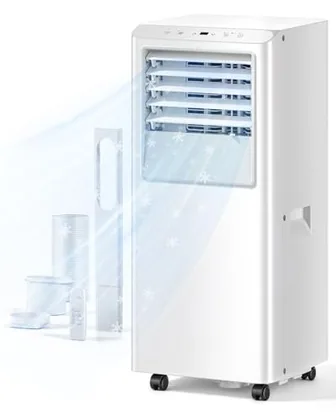
Portable Air Conditioners
8,000 BTU Portable Air Conditioner
$159.99
Portable Air Conditioners
14,000 BTU Portable Air Conditioner
$239.99
Sources
Read in full before anything above was written, on the dates given.
- U.S. Department of Energy: Purchasing Energy-Efficient Room Air Conditioners · read 17 August 2026
- U.S. Department of Energy: Portable Air Conditioners · read 17 August 2026
More from the journal
- Sizing a 12-volt fridge: what quarts actually hold · 11 min read
- Running cold off-grid without killing the battery · 11 min read