Power · 2,525 words · 11 min
Running cold off-grid without killing the battery
Every fridge we make does one job: it holds a temperature. Away from a wall socket, that job becomes a negotiation with a battery, and the negotiation has rules. This guide is the set of rules we would hand any owner heading past the last power hook-up: how long food actually stays safe when the cold stops, why a compressor changes that arithmetic, what our battery protection cut-offs really do, and the packing and power habits that stretch a night of battery into a weekend of cold.
None of it requires an electrical engineering degree. Most of it requires a habit or two.
The clock that starts when the cold stops
Start with the stakes, because they are sharper than most people think. The federal agency that publishes guidance on food in power emergencies puts plain numbers on how long an unpowered box protects its contents:
The refrigerator will keep food cold for about 4 hours if it is unopened.
A full freezer will keep the temperature for approximately 48 hours (24 hours if it is half full) if the door remains closed.
Four hours for a refrigerator. Two days for a freezer that is both full and left shut, and half that when it is half full. Those figures describe a well-insulated household appliance standing still in a kitchen. A box rattling in a hot boot, opened at every fuel stop, does worse. Set against those clocks, this is the whole off-grid problem in one table:
| Box | Keeps safe cold for | Condition |
|---|---|---|
| Household refrigerator | about 4 hours | door kept closed |
| Full freezer | about 48 hours | door kept closed |
| Half-full freezer | about 24 hours | door kept closed |
| 12V compressor fridge | as long as the battery holds | it keeps making cold, not just holding it |
Outage figures from the FDA guidance quoted above; the 12V row is the point of this article, not an FDA figure.
The last row is the argument of this guide. Ice and thermal mass only slow the warming down. A compressor, fed even a modest amount of power, stops the clock entirely, and the question becomes how to feed it well.
Why a compressor wins this race
A quick tour of the machine, because the power habits below all follow from it. A compressor fridge moves heat the way a kitchen refrigerator does: a pump compresses refrigerant, the refrigerant releases heat outside the box and absorbs it inside, and the chamber settles at whatever number you set. Two properties matter off-grid.
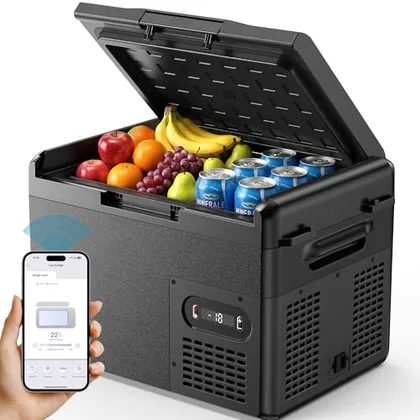
First, the compressor cycles. It runs hard to pull the chamber down to temperature, then rests, then runs again briefly to hold the line. A box that is cold, full and closed spends most of each hour resting, and a resting compressor draws almost nothing. Your battery is not paying for cold by the minute. It pays for recovery, every time warmth gets in.
Second, cooling power scales with need. A thermoelectric cooler can only push a fixed temperature step below the surrounding air, so a hot afternoon simply moves its floor upward. A compressor holds its set point in a hot car, in July, and every Feelfunn refrigerator runs one.
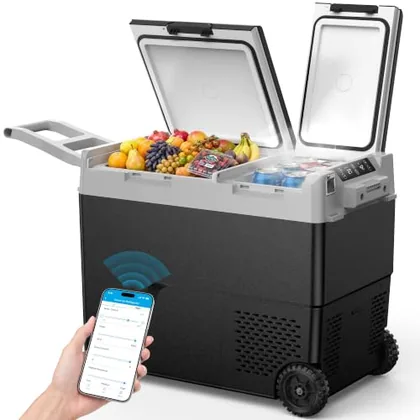
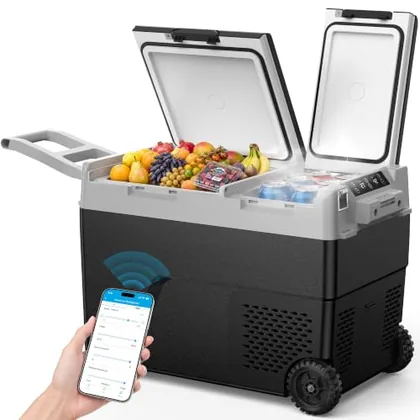
12V Car Refrigerators
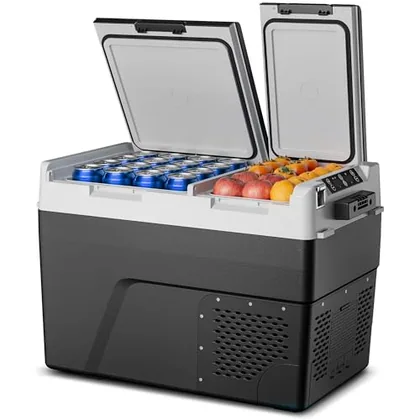
61 Qt 12V Car Refrigerator Dual Zone, Black
$269.99


We wrote about what that means for choosing a size in the sizing guide. Here it means something else: the machine will keep its promise for exactly as long as you keep the battery's promise. So the rest of this page is about the battery.
Battery protection: the cut-off is the contract
Every 12-volt box we make ships with battery protection, selectable across cut-off levels. It watches the voltage of whatever battery feeds it, and when that voltage sags to the chosen threshold, the fridge shuts itself down rather than drain the last of the charge. The point is blunt and practical: a fridge must never be the reason a vehicle fails to start.
The high cut-off is the setting for a vehicle's starter battery. It surrenders early, while the battery still holds ample charge to crank the engine. Use it whenever the fridge runs from the socket of a vehicle you intend to start again, which is to say, use it by default.
The low cut-off exists for dedicated power: a second house battery, a portable power station, any supply whose only job is running appliances. It lets the fridge draw the battery much further down before giving up, because nothing needs to be cranked afterwards. Setting the low cut-off on a starter battery is the classic self-inflicted wound of this category. The fridge will obediently run all night, and the morning will be quiet in the wrong way.
The middle setting, where a unit offers one, splits the difference for batteries that do double duty. If you are unsure which battery you have, choose the higher protection and accept the earlier shutdown. An hour of lost cold is recoverable. A flat starter battery at a trailhead is a different kind of afternoon.
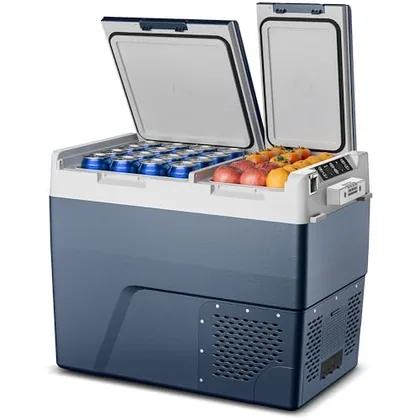
12V Car Refrigerators
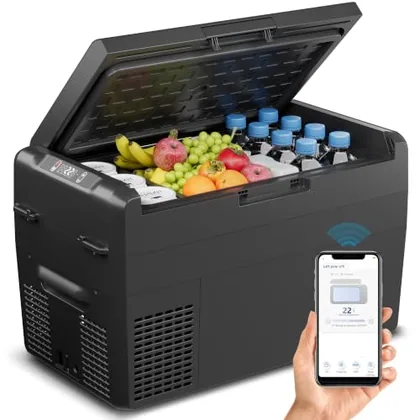
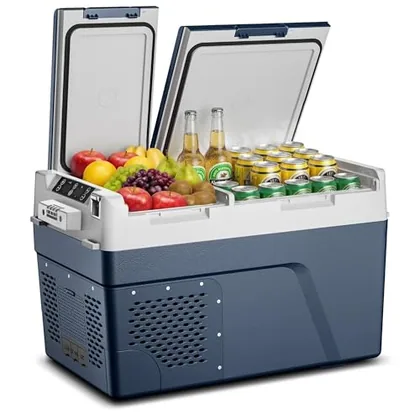
50 Qt 12V Car Refrigerator Dual Zone, Black
$249.99
One honest note on numbers: cut-off thresholds and power draw vary by model and are stated on each unit and its plate. There is no single true wattage for the range, so read the plate of the box you choose.
The load matters as much as the machine
The cheapest amp-hours are the ones the compressor never has to spend, and most of them are decided before the engine starts. Four habits do most of the work:
- Start cold. Chill the box and everything going into it from the house supply the night before. A compressor asked to pull a warm load down to temperature off-grid will do it, and will spend a large slice of your battery doing what the kitchen could have done for free.
- Start full. Cold food and drink are thermal ballast: the more chilled mass inside, the less the temperature swings with every opening, and the less recovery work the compressor buys back. Fill spare space with drinks or frozen water bottles.
- Open briefly, open rarely. Warm air enters at every opening and the compressor pays to chase it back out. The federal outage guidance above gives the same advice for a dead fridge, and it is worth quoting for a live one too, because with a battery, doors cost money:
Foods held at temperatures above 40 °F for more than 2 hours should not be consumed.
That sentence is about food that has already warmed, and it is the line you never want to reach. Keeping openings short and few is how you stay far away from it.
- Freeze the reserve. On multi-day trips, run frozen food as the second half of the menu. A dual-zone box makes this explicit: one side stays shut and frozen as the pantry, the other side works as the daily fridge. The frozen mass also steadies the whole chamber, the same physics the FDA relies on when it tells households a full freezer outlasts a half-full one.
Where the power comes from
Off-grid power arrives in four common shapes, and the fridge is agnostic among them as long as the voltage is right. What differs is how each one wants to be treated.
The vehicle's 12-volt socket is the default and needs the least thought while driving: the alternator carries the fridge and charges the battery at the same time. Parked is when discipline starts. A starter battery is designed to deliver one violent burst and be refilled, not to be drawn down for hours, so parked running belongs on the high cut-off, and an overnight stop is about the sensible limit to plan for.
A second battery is the classic camper's answer: a deep-cycle house battery, isolated from the starter circuit, refilled by the alternator on driving days. Deep-cycle chemistry tolerates the long slow draw a fridge represents, and the isolation means the worst case costs you cold rather than ignition. This is the setup the low cut-off was built for.
Portable power stations have made the second battery portable and plug-and-play. Match the station's rated output to the fridge's stated draw, and prefer a station you can recharge while it works, from the vehicle by day or from a panel at camp. A station that must choose between charging and running spends half its life on the wrong job.
Solar panels close the loop for stays longer than a battery. The honest framing is that a panel does not run the fridge, it refills the battery that runs the fridge: cloud, shade and evening all pass through the battery as a buffer. Size the panel to replace a day's draw with a margin for weather, and remember the draw itself is on the unit's plate, not in a guide's average.
Whatever the source, one rule repeats: the fridge should be the best-informed load on the circuit. Its cut-off must match the battery it actually feeds from, not the battery it fed from last month.
Heat management: the silent half of the budget
Every degree of heat kept away from the box is battery kept in the bank. Three placements do more than any accessory:
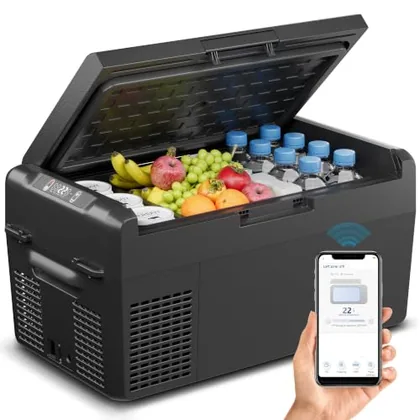
12V Car Refrigerators
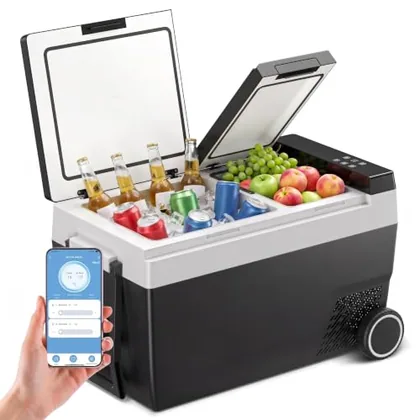
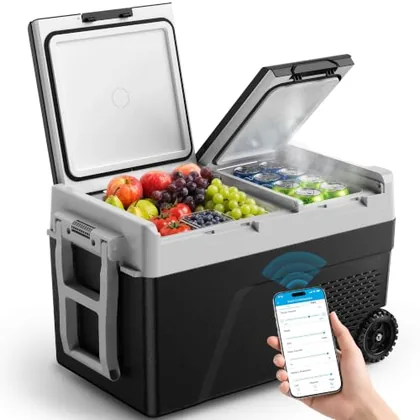
40 Qt 12V Car Refrigerator Dual Zone, Black
$237.99
- Shade beats everything. A box in direct sun fights the sun all day. Under a seat, under a canopy, under anything, the compressor's workload drops sharply. If the interior of the vehicle bakes while parked, crack the windows or move the box out to shaded ground.
- Ventilation is not optional. The compressor dumps the chamber's heat through vents in the housing, and it needs air moving past them to do it. Packed tight against luggage on both sides, the box re-breathes its own exhaust and runs longer cycles for the same cold. Leave the vent faces clear by a hand's width.
- Off the hot floor. A metal boot floor over an exhaust line can run hot enough to feel through a boot mat. A slatted base, a folded blanket, anything that breaks contact, keeps the chamber from absorbing heat through its least insulated face.
None of this shows up on a spec sheet, and together it is often the difference between a battery that lasts the weekend and one that taps out on the second afternoon.
A worked overnight, start to finish
To pull the threads together, here is a two-night, no-hook-up trip as we would run it, with the reasoning attached.
The night before, the box comes indoors, plugs into the wall, and gets loaded cold: the frozen side packed solid with the second day's meals and spare water bottles, the fridge side layered with the working food on top. In the morning it rides to the vehicle already at temperature, and the drive out is free running on the alternator.
At camp, the box goes under the vehicle's shade side, vents clear, up on a slat base. If it feeds from the starter battery, protection goes to the high cut-off before the first drink comes out, and the evening's openings get consolidated: drinks for the table travel in one opening, not six. Overnight the full, closed, already-cold box mostly rests.
Day two is the test day. Driving tops the battery back up. If the vehicle stays parked, the box either moves to its own power station or stays on the high cut-off with the plan accepted in advance. Should protection trip in the small hours, the chamber is full, cold and shut, and that is the configuration the FDA's outage clocks describe as slowest to warm. Breakfast comes out of a box that never left its safe band, and the frozen reserve carries dinner.
Opened unit to air out plastics smell, fine after 12 hours.
The trip home reverses the loading: whatever crossed into the danger-zone hours at any point does not come back into the menu. With the habits above, on a working setup, nothing should have.
The other extreme: cold weather and the fridge
Off-grid does not only mean July. A compressor box in winter behaves differently in two ways worth knowing before a ski trip or a cold-country haul.
The pleasant surprise is the workload. When the air around the box sits near the set point, the compressor barely runs, and battery life stretches far past its summer figures. A box holding fridge temperature in a 40°F garage is nearly coasting. The margin you fought for in August arrives free in January.
It also has a battery protection feature that will shut the cooler off if your vehicle battery drops below a set voltage and you have three choices for that voltage with this.
The catch is the other direction. A fridge cannot heat, so when the surroundings drop below the set point, the chamber follows the weather down. Milk on the fridge side of a box left in a hard-freezing vehicle overnight will freeze, not because the machine failed but because nothing asked it to fight the cold.
In freezing conditions, treat the vehicle cabin as the warmer room, keep the box inside it rather than in an exposed bed or trailer, and check the chamber in the morning the way you would check a cabin's pantry. The temperature display reads the truth either way, and reading it is the whole habit.
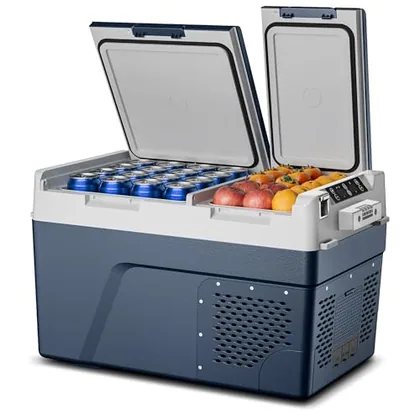
FYI, this doesn't have a battery so you'll need a 12v/110v power source!
Winter also softens the battery mathematics from the other side. Batteries themselves deliver less in deep cold, so what the compressor saves in workload, the chemistry partly takes back. The cut-off settings do not change: high on a starter battery, in any season.
Power questions owners actually ask
Can the fridge run while the vehicle is off? Yes, that is the normal parked mode, and it is exactly what the cut-off supervises. On a healthy starter battery with the high cut-off set, an overnight is the sensible plan. For longer, move the load to dedicated power.
Does it matter which 12-volt socket I use? It can. Some vehicle sockets go dead with the ignition, others stay live. A socket that dies at key-off simply stops the fridge, no harm done but no cold made either. Learn which kind yours is on the driveway, not at the campsite.
I have used this on about 3 camping trips and other various trips so far paired with an Ecoflow battery and I am pleasantly surprised at the results.
Will the fridge restart itself after protection trips? Once the supply recovers past the threshold, the box resumes holding its setting. Your job is the supply side: drive, swap the battery, or plug into the station. The settings survive.
Can I run it from a wall socket at a cabin? The models with a household adapter state it plainly on their pages. Wall power at night plus 12-volt on the road is the most relaxed setup there is, and it is how we would run any trip that touches mains at either end.
Is a bigger battery always the answer? It is an answer, and often the most expensive one. Before buying amp-hours, spend the free currency first: pre-chill, pack full, shade the box, clear the vents, open less. The habits routinely buy back more running time than the next battery size up would, and they weigh nothing.
The checklist, in one place
The 61QT capacity provides plenty of room for drinks, food, and snacks, making it great for road trips, camping, and long drives.
- Chill the box and its contents on wall power before leaving.
- Pack full. Use frozen bottles as ballast in the spare quarts.
- Match the cut-off to the battery: high on a starter battery, low only on dedicated power.
- Park the box in shade, vents clear, off hot metal.
- Open briefly and rarely. Consolidate the fetches.
- Run frozen reserves for the back half of the trip.
- On multi-day stays, refill the battery by day: alternator, station or panel.
- When protection trips anyway, keep the lid shut and drive: a full cold box buys you hours.
I then decided to get the 50 quart cooler and I am much happier with it.
The machine's half of the contract is engineering: a compressor that holds -4°F on the models that state it, and a cut-off that guards the ride home. Your half is habits, and they are cheap. Between the two, the last hook-up stops being the edge of the cold. If you are still choosing which box to take past it, the quart arithmetic lives in the sizing guide, and the whole 12-volt line is on one shelf.
Sources
Read in full before anything above was written, on the dates given.
- FDA: Food and Water Safety During Power Outages and Floods · read 17 August 2026
- USDA FSIS: Refrigeration and Food Safety · read 17 August 2026
More from the journal
- Sizing a 12-volt fridge: what quarts actually hold · 11 min read
- What a BTU buys: matching portable AC to a room · 11 min read