Sizing · 2,554 words · 11 min
Sizing a 12-volt fridge: what quarts actually hold
We rate every 12-volt refrigerator we make in quarts, and we get more questions about that one number than about anything else on the box. It sounds abstract. Nobody shops for groceries in quarts. But the quart is the honest unit for a portable fridge, and once you can read it, choosing between our 14 car refrigerators takes about five minutes.
This guide is that five minutes, stretched out with the working shown: what the number measures, what 16, 32 and 61 quarts hold in real food, when a second zone earns its price, and how to check the whole plan against the space behind your seat.
What a quart rating measures
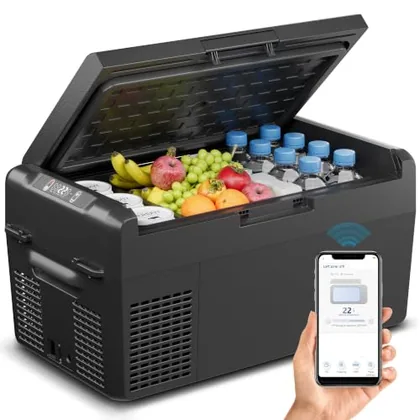
A quart is a quarter of a gallon, a shade under a litre. When we print 32 quarts on a fridge, we mean the usable volume of the inner chamber: the space you can actually fill, measured with the basket in and the lid closed.
It is the same convention the cooler industry has used for decades, and we keep it for a plain reason. If you have ever owned an ice chest, you already have a feel for what your family eats out of a 40-quart box on a weekend, and that instinct transfers straight across.
There is one difference worth stating early. In an ice chest, a third to a half of the rated volume goes to the ice itself before any food goes in. A compressor fridge gives you the whole chamber, because the cold comes from a machine rather than from a melting block.
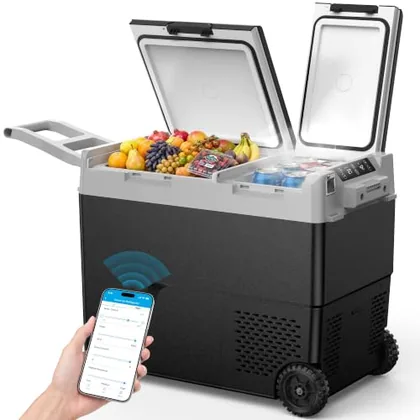
12V Car Refrigerators
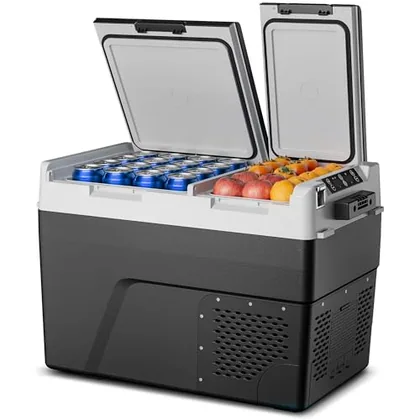
61 Qt 12V Car Refrigerator Dual Zone, Black
$269.99


A 32-quart fridge therefore carries roughly what a 45 to 50 quart cooler carries once you subtract the ice, and it carries it at a set temperature instead of a rising one. When you compare our boxes against the cooler you are replacing, compare against the cooler's food space, not its printed size.
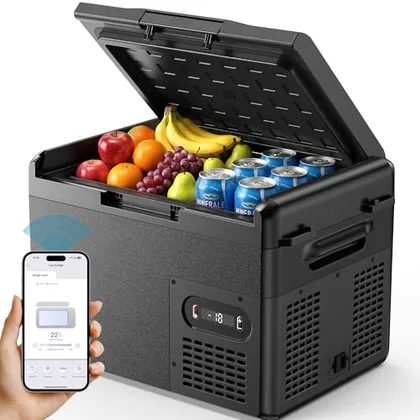
The quart, translated into groceries
Numbers first, then the shorthand. A 12-ounce drink can is about 0.4 quarts of space once you allow for the gaps between cylinders. A quart of milk is, conveniently, a quart. A standard grocery bag of mixed food settles at around 12 to 15 quarts. From there:
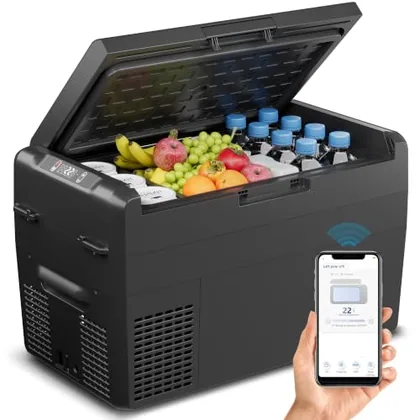
- 16 quarts is a day-trip box: drinks and lunch for two or three people, or a week of work lunches for one. It fits a footwell or the gap behind a truck console.
- 20 to 30 quarts covers a weekend for two: a grocery bag of food plus a case of drinks, with room for the things you buy on the way.
- 32 to 40 quarts is the family camping size: two to three grocery bags, a couple of days for four people before anyone rations anything.
- 45 to 61 quarts is expedition territory: a week for two, a long weekend for a family, or hunting and fishing trips where the box comes home heavier than it left.
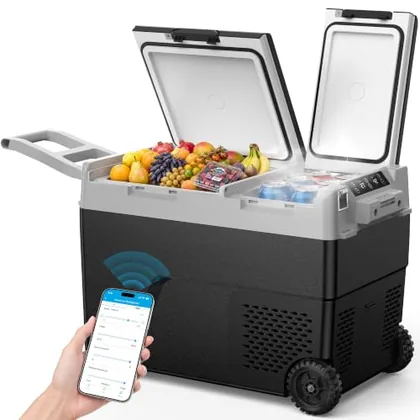
12V Car Refrigerators
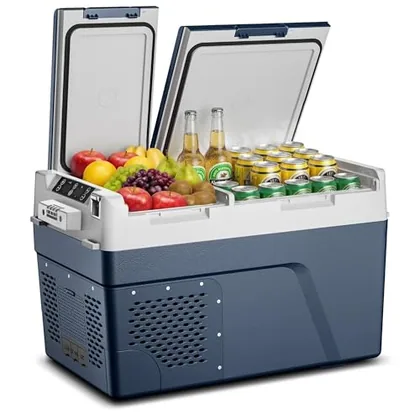
50 Qt 12V Car Refrigerator Dual Zone, Black
$249.99
Those bands are how we sort our own shelves. The under-40-quart boxes are the daily and weekend sizes, and the over-40-quart boxes are the ones you choose when the trip is measured in days rather than hours.
The whole line, one table
Every 12-volt box we currently make, smallest to largest, with its zone count and the coldest setting it states. The prices are from our latest update, and the day of that update is on the quality page.
| Model | Quarts | Zones | Coldest | Price |
|---|---|---|---|---|
| 16 Qt 12V Car Refrigerator | 16 | Single | stated on unit | $129.99 |
| 21 Qt 12V Car Refrigerator | 21 | Single | stated on unit | $149.99 |
| 27 Qt 12V Car Refrigerator | 27 | Single | stated on unit | $169.99 |
| 40 Qt 12V Car Refrigerator Dual Zone, Black | 40 | Dual | -4°F | $237.99 |
| 40 Qt 12V Car Refrigerator Dual Zone | 40 | Dual | -4°F | $199.99 |
| 40 Qt 12V Car Refrigerator Dual Zone | 40 | Dual | -4°F | $199.99 |
| 40 Qt 12V Car Refrigerator | 40 | Single | -4°F | $199.99 |
| 40 Qt 12V Car Refrigerator | 40 | Single | -4°F | $199.99 |
| 50 Qt 12V Car Refrigerator Dual Zone, Black | 50 | Dual | -4°F | $249.99 |
| 50 Qt 12V Car Refrigerator Dual Zone | 50 | Dual | -4°F | $219.99 |
| 55 Qt 12V Car Refrigerator | 55 | Single | -4°F | $239.99 |
| 61 Qt 12V Car Refrigerator Dual Zone | 61 | Dual | -4°F | $239.99 |
| 61 Qt 12V Car Refrigerator Dual Zone, Black | 61 | Dual | -4°F | $269.99 |
| 61 Qt 12V Car Refrigerator Dual Zone | 61 | Dual | -4°F | $239.99 |
Two things stand out in that table if you read down the columns. The zone column is not decoration, and we will get to it below. And the coldest column is not a marketing flourish either: a box that reaches deep freezing temperatures is doing something a cooler physically cannot, whatever the cooler's size.
Why the temperature column matters more than the size column
Here is the part of sizing that has nothing to do with volume. Food safety in the United States is framed around one temperature band, and the government agency that regulates meat and poultry describes it like this:
Bacteria grow most rapidly in the range of temperatures between 40 and 140 °F, the "Danger Zone," some doubling in number in as little as 20 minutes. A refrigerator set at 40 °F or below will protect most foods.
An ice chest starts its trip inside that safe zone and spends the rest of the weekend drifting out of it. A compressor fridge holds the number you set for as long as it has power. That is the real reason to move from ice to a compressor, and it is why we would rather you buy a correctly sized 20-quart fridge than an oversized cooler. The same agency makes the second half of the argument for us:
Pathogenic bacteria can grow rapidly in the "Danger Zone," the temperature range between 40 and 140 °F, but they do not generally affect the taste, smell, or appearance of a food.
You cannot smell your way out of a warm box. The fix is a box that does not go warm. Whichever size you land on, that part of the decision is already made the moment you choose a compressor.
Dual zone: when the second setting earns its keep
8 of our 14 car refrigerators are dual zone. The chamber is split by an insulated divider, each side runs its own set point, and the compressor serves both. One side holds drinks and vegetables at fridge temperature while the other holds meat and ice cream frozen solid.
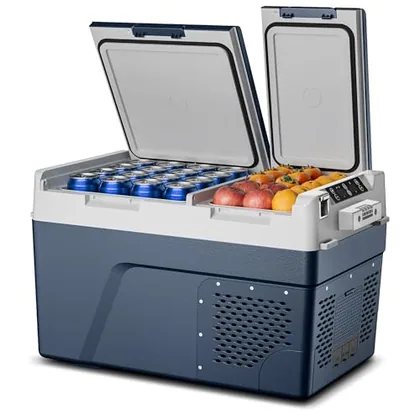
Whether that is worth paying for comes down to a single question: does your trip involve frozen food? If the box carries drinks, fruit, sandwiches and condiments, a single zone at 37°F does everything you need, and the divider would only cost you flexibility. If the box carries a week of meat for a fishing camp, or you have promised children ice cream on the third day, the second zone stops being a luxury.
Splitting one chamber between "cold" and "frozen" without a divider is not a compromise, it is a failure at both jobs: the freezer items thaw or the salad freezes.
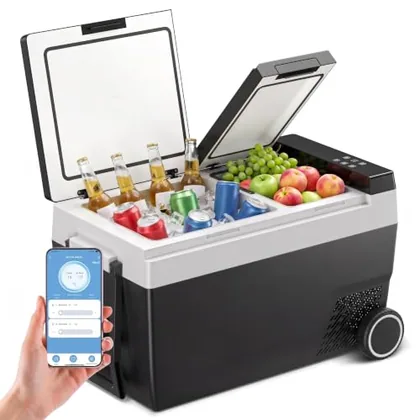
There is a quieter benefit we hear about from long-haul drivers. A dual-zone box lets you run one side as a deep reserve. Meat for the back half of the trip stays frozen on one side while the working food lives on the other, which means the lid over the frozen side opens twice a day instead of twenty times.
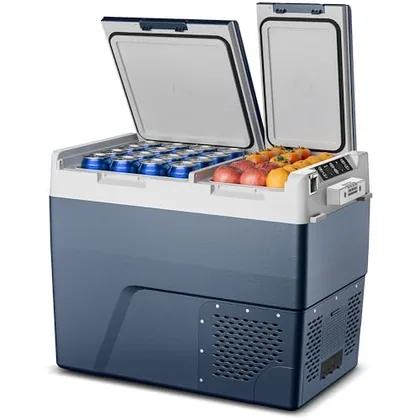
How cold our boxes actually run
The table below lists the stated temperature ranges across the line, coldest first. A set point of -4°F is well below household freezer temperature, and holding it in a hot vehicle is the compressor's whole argument.
| Model | Range | Zones | Weight |
|---|---|---|---|
| 61 Qt 12V Car Refrigerator Dual Zone | -4°F to 68°F | Dual | 38.8 lb |
| 61 Qt 12V Car Refrigerator Dual Zone, Black | -4°F to 68°F | Dual | 44.6 lb |
| 50 Qt 12V Car Refrigerator Dual Zone, Black | -4°F to 68°F | Dual | 42.1 lb |
| 61 Qt 12V Car Refrigerator Dual Zone | -4°F to 68°F | Dual | 38.8 lb |
| 55 Qt 12V Car Refrigerator | -4°F to 68°F | Single | 38.4 lb |
| 40 Qt 12V Car Refrigerator Dual Zone, Black | -4°F to 68°F | Dual | 40.6 lb |
| 50 Qt 12V Car Refrigerator Dual Zone | -4°F to 68°F | Dual | 37.26 lb |
| 40 Qt 12V Car Refrigerator Dual Zone | -4°F to 68°F | Dual | 35.71 lb |
A note on reading these ranges honestly, because we would rather undersell than surprise you. The low end of a range is a set point, not a permanent state: a box working in direct summer sun, opened every few minutes, will cycle around its target rather than sit exactly on it.
The engineering promise is that it recovers on its own and does not drift upward all afternoon the way ice does.
The space it takes, and the weight you lift
A quart rating tells you what fits inside the box. It says nothing about whether the box fits inside the vehicle, so measure twice before you decide on a size. Three checks, in the order people skip them:
- The footprint. Measure the flat space where the fridge will sit, then check it against the dimensions on the product page. Boot floors are rarely as rectangular as they look, and wheel arches steal more width than you remember.
- The lid swing. A fridge opens upward. In a hatchback with a low parcel shelf, or under a truck canopy, make sure the lid clears whatever sits above it. A box you must drag out to open gets opened less, which sounds like a virtue and is actually a nuisance.
- The loaded weight. Our biggest boxes weigh what a full suitcase weighs before any food goes in. Add forty quarts of groceries and drinks and you are lifting a real load. If one person will carry the box to a campsite, that argues for two smaller boxes over one large one, and it is the single most common piece of advice we give.
The strap points and handles on our boxes are sized for the loaded weight, not the empty one. Even so, physics is physics: past 45 quarts, plan for two people or a tailgate-height resting spot.
A sizing walk-through, three real trips
Abstract bands are useful, but most people recognise themselves faster in an example. Here are three, worked from the same arithmetic we used for the bands above.
The commuter and weekend errand runner. One person, drinks and lunch on workdays, a farmers-market haul on Saturday. A grocery bag is 12 to 15 quarts and the daily load is far less. The 16 to 20 quart end of the small boxes covers this with room to spare, runs happily from the 12-volt socket, and lifts with one hand. Buying bigger "just in case" costs boot space every single day for a case that comes twice a year.
12V Car Refrigerators
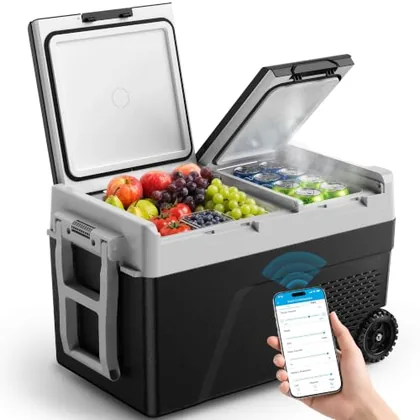
40 Qt 12V Car Refrigerator Dual Zone, Black
$237.99
The family of four, two-night campground trips. Two grocery bags of food, a case of drinks, milk for breakfast, and something frozen for the second night. That is 30 to 38 quarts of real cargo. A 32 to 40 quart box fits it without crushing the bread, and if the frozen item matters, this is the smallest trip profile where dual zone starts to pay. One size up buys slack for longer trips at the cost of weight, and this is the fork in the road most buyers stand at.
The two-week expedition, two people. Here the box is the pantry. A week of meals for two runs past 50 quarts once you count meat, dairy, vegetables and the drinks that never seem to fit anywhere else. This is what the 61-quart end of the big boxes is for, almost always as a dual zone, with the frozen side packed as the second week's reserve.
Owners at this end of the line think hardest about power, and we wrote a separate guide on running cold off-grid for exactly that half of the plan.
The mistakes we would steer you around
After enough conversations with owners, the same handful of sizing mistakes keeps coming back. In the spirit of saving you an email:
Because it can get heavy when fully loaded, it is best to place the empty cooler in your vehicle before packing your food and drinks into it.
- Buying by the old cooler's number. A 50-quart cooler was never 50 quarts of food. Subtract the ice before you match sizes, or you will buy one size larger than you need.
- Ignoring the vehicle. The most common return-shipping story in this category, industry-wide, is a box that did not fit under the canopy. Measure the space, then the lid swing.
- Sizing for the biggest trip of the year. A box you use every weekend should fit the weekend. Renting slack for the annual expedition by packing tighter beats hauling empty quarts fifty weekends a year.
- Forgetting that air is cargo. A half-empty fridge cycles more, because every lid opening swaps its cold air for warm. If you routinely run half empty, you bought too big. Fill the spare space with drinks: they cost nothing to keep cold and they smooth the temperature swings.
- Treating dual zone as the premium default. If nothing in your box is frozen, a single zone of the same quarts is simpler, roomier for the money, and one less setting to think about.
Packing so the quarts work harder
It is a better size and not as heavy to carry around which makes it nice for me.
Once the box is chosen, packing decides how big it feels in practice. The same 32 quarts can carry a tidy week or a jumbled weekend, and the difference is habit rather than hardware.
Cold air pools at the bottom and spills out over the rim every time the lid opens. So the bottom layer belongs to the things that must stay coldest and get touched least: meat, dairy, anything delicate. The top layer belongs to the things fetched constantly, drinks above all, because a two-second grab from the top costs the box far less than a rummage to the floor.
The basket that ships with our boxes is not packaging, it is the working top layer: lift it out once and the whole lower stratum is in reach, instead of being excavated item by item while the cold drains out.
Not having to deal with melting ice means no more soggy food and a surprising amount of extra storage space inside the cooler.
Square containers beat round ones by a surprising margin. A chamber packed with rectangular boxes uses nearly all of its rated quarts, while a jumble of jars, bags and tubs strands space in every gap. Repacking meat out of bulky shop trays into flat sealed containers routinely recovers a fifth of the volume, which is the difference between one size and the next on the shelf, for free.
And chill everything before it goes in. A compressor will happily pull a warm case of drinks down to temperature, but it will spend real battery doing it, and the food already inside rides the warm spike alongside. Load the box cold from the house fridge and it starts its trip already won. This matters twice over once the power comes from a battery, and the off-grid guide does that arithmetic properly.
Sizing questions we actually get
Another small con is that it does seem to drop temperature relatively quickly when turned off from my experience.
Is bigger safer, since food has more cold mass around it? No. A correctly filled small box holds temperature at least as well as a half-empty big one, because the enemy is the air exchange at every opening, not the size. Buy for the real load.
Do quarts include the basket? Yes. The rating is the usable chamber with the basket in place. Take the basket out and you gain its walls, a quart or so, and lose the layering.
Can I run a single zone as a freezer for the whole trip? You can, the set points reach well below freezing on the models that state it. You then have no fridge side, so it suits dedicated jobs, hauling a hunt home, rather than mixed family loads.
I then decided to get the 50 quart cooler and I am much happier with it.
Two small boxes or one big one? Two boxes cost more per quart and draw two sets of power, but they split the carrying weight, let one run frozen and one chilled like a dual zone, and one can stay home on small trips. Households that camp in different configurations through the year often land on the pair.
What about the other lines? The quart logic is car-fridge specific. Indoors we count in cans and bottles instead, across our 24 beverage and mini fridges, and the number on those pages answers the matching question: how many drinks fit behind the glass door.
Where to start on the shelf
The 61QT capacity provides plenty of room for drinks, food, and snacks, making it great for road trips, camping, and long drives.
If you want the short version after all the working: day trips and commutes, 16 to 20 quarts. Weekends for a family, 32 to 40, dual zone if the freezer side will actually be used as one. Expeditions, 45 quarts and up, dual zone almost by default. The two boxes below are the ends of our own line, and between them sit the other 14 minus two, every one rated in the same honest quarts.
Whichever end you start from, the quart number on the box means the same thing: usable space, measured with the lid closed, cooled by a compressor that holds its setting. Read it next to your own trips, check it against the boot, and the size chooses itself. And once the size is settled, the next question is power, which has its own arithmetic and its own guide.
Sources
Read in full before anything above was written, on the dates given.
- USDA FSIS: Refrigeration and Food Safety · read 17 August 2026
More from the journal
- Running cold off-grid without killing the battery · 11 min read
- What a BTU buys: matching portable AC to a room · 11 min read